



Hanadama Pearls vs. Akoya Pearls: Differences and Quality Standards

Is a Hanadama pearl a different kind of pearl from an Akoya pearl? And what explains the price difference? If you've wondered about either, you're not alone.
Hanadama is one of the best-known quality labels you'll see when shopping for Akoya pearls. The name alone doesn't say much, though, and it can be hard to tell how Hanadama differs from other Akoya pearls or what to actually look at when you choose.
In this guide, we'll start by placing Hanadama within the Akoya family. From there, we'll cover how it compares with non-Hanadama Akoya, what to look for in quality, what a certificate tells you, and the occasions when Hanadama makes sense.
What Are Hanadama Pearls?

Hanadama (Japanese for "flower pearl") is a quality label given to white Akoya pearls that meet the standards of a pearl appraisal laboratory. Every Hanadama pearl is an Akoya pearl, and no special Hanadama oyster or species exists.
A pearl sold as Hanadama is evaluated on several factors at once, including Luster, Nacre thickness (nacre is the lustrous coating that builds up around the pearl), Surface and Shape. The balance across all of them matters more than any single strength.
It helps to hold onto one idea from the start: Hanadama describes the quality of an Akoya pearl. Once that clicks, every comparison that follows gets easier.
Hanadama Pearl Basics
Akoya pearls don't all come out of the water at the same quality. Color, shape, luster and surface differ from pearl to pearl. After harvest, they're sorted and processed, then made into jewelry that suits what each pearl has to offer.
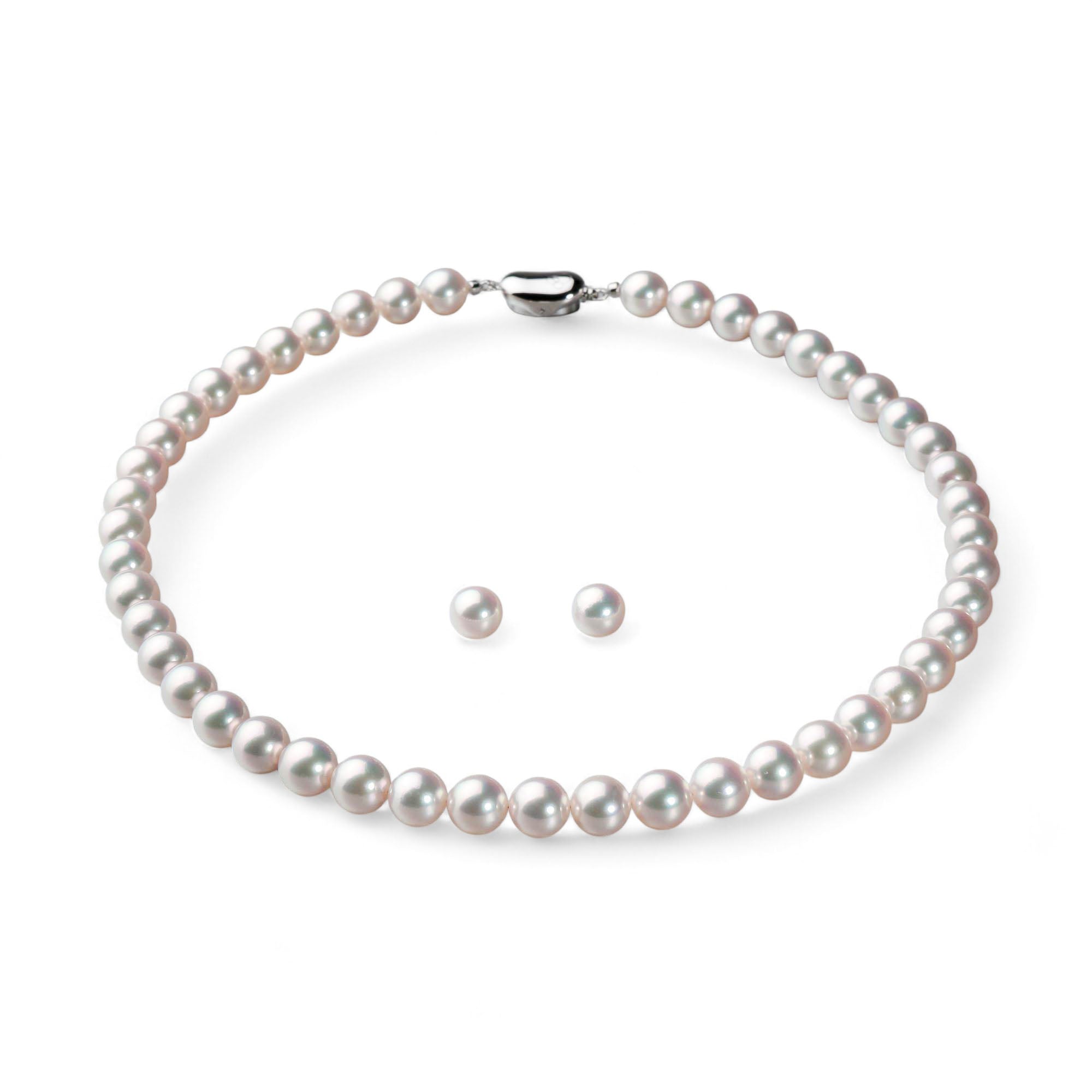
Hanadama pearls are some of the Akoya pearls chosen in that process. With necklaces especially, how well the color, luster and shape agree across the whole strand shapes the finished piece as much as each individual pearl does.
So when you look at Hanadama, consider more than the "certified pearl" label. The skill of the craftspeople who read each pearl and match it to its neighbors matters just as much.
Why Hanadama Pearls Stand Out
One reason people choose Hanadama is that it gives you a benchmark. If quality is what you're shopping for, a reference point makes comparing pieces easier.
Say you're looking for a gift for a milestone like a coming-of-age celebration or a wedding, or a necklace you'll wear for years to ceremonial occasions. When you want to feel sure about a meaningful piece, a Hanadama pearl necklace that has passed a set level of quality checks is often a natural candidate.
Hanadama pearls also go through several steps, including sorting and inspection, so they can cost more than other Akoya pearls. Price still depends on pearl size, quality and how the piece is made. Compare piece by piece, since the Hanadama label doesn't set the price on its own.
Shop All Hanadama Akoya Pearls
How Hanadama Pearls Differ From Other Akoya Pearls

Hanadama Is a Type of Akoya Pearl
The easiest way to see how Hanadama relates to non-Hanadama Akoya is to drop the idea of two separate types. Think of Hanadama as a position within the same Akoya family.
Akoya pearl names a type of pearl. Hanadama is the name given to white Akoya pearls that meet certain conditions. That's why every Hanadama pearl is also an Akoya pearl.
Seeing it this way changes the question. Instead of "Hanadama or Akoya?", you can ask, "Which quality level and price range within Akoya suits me?"
How the Quality Standards Differ
When you assess the quality of a Hanadama pearl, no single number tells the whole story. What matters is how several factors work together.
The main ones are Luster (the glow that makes a pearl shine), Nacre thickness (the condition of the nacre layer), Surface (any marks or texture on the pearl) and Shape. For a necklace, how evenly the pearls match in color, luster and shape also affects the overall impression.
Also, pearls don't have one worldwide standard like the 4Cs used for diamonds. So it's worth looking beyond the word "Hanadama" when you compare pieces. Check how the actual pearls appear and how the seller selects them, and you'll feel more confident in your choice.
Hanadama vs. Non-Hanadama Akoya: Which Should You Choose?
A helpful way to choose is to start with how you'll use the pearls and what matters most to you.
Hanadama is a natural candidate if you want a single-strand necklace to wear for years to weddings, funerals and other ceremonial occasions, or a gift for a milestone like a coming-of-age celebration or a wedding. It also suits you if you like having objective information about quality on hand while you choose.
On the other hand, if you're after a pendant or earrings for everyday wear, a design-forward piece, or a good balance with your budget, searching across the full range of Akoya pearls opens up more options.
Try not to assume Hanadama is automatically the better fit. Comparing on four points tends to make it clearer: use, design, how beautiful the actual pearls look to you, and budget.
Shop All Hanadama Akoya Pearls
What to Look For in Hanadama Pearl Quality

When you compare Hanadama pearls, try not to judge by the name alone. Look at the individual qualities that make up each pearl's beauty, one at a time.
Luster, nacre thickness and surface are the ones to focus on. They can look like separate checkboxes, but they influence each other and together create the pearl's overall impression.
For example, a pearl with a few marks on it may hardly show them if its luster is strong. On the other hand, a pearl with very few marks can look quite different depending on its luster. Let's go through each one.
Luster: Sharp Reflection and Real Depth
Luster is the shine you see and the way light returns from the pearl. In a good Hanadama pearl, you'll often notice two things. One is a clear reflection, where you can make out the surroundings mirrored on the surface. The other is a depth of glow that seems to come from the nacre beneath.
When you check luster, look past "is it bright?" Ask whether the reflection is crisp and whether the whole pearl feels three-dimensional.
With a necklace, don't stop at a single pearl. See whether the luster of the pearls side by side comes together as a whole.
Nacre Thickness: Where Depth and Color Come From
Nacre thickness describes the condition and thickness of the nacre that forms around the nucleus (the small bead at the center of the pearl). Because nacre bounces light between its layers, it shapes both the luster and the soft colors that shift across the surface.
A pearl with rich nacre can look as if it's glowing from within, with more depth than a bright surface alone.
That said, thick nacre doesn't automatically make a pearl beautiful. The final impression comes from how it combines with luster, surface condition and color, so the overall balance is what counts.
Surface: A Smooth Finish Makes the Pearl Look Clear
Pearls grow inside a living oyster, so small bumps or dimple-like marks can show up on the surface. These natural features are different on every pearl.
In general, the fewer noticeable marks and the smoother the surface looks, the cleaner the pearl appears. Still, where the marks sit and how big they are matter as much as the count, along with how they balance with the luster.
For instance, some marks sit where they're hard to notice when you're wearing the pearl, and others fade behind a strong luster. With necklaces and earrings, try picturing how the pearl will look when worn.
Certificates: The Reassurance of Certified Hanadama Pearls
If you're choosing Certified Hanadama Pearls, check the certificate that comes with them. A certificate is a document that records the results of an inspection by an independent appraisal laboratory.
A certificate is a good start. Next, look at which laboratory issued it and what it lists, such as the pearl type, size and quality details. Reading it that way helps you understand the pearls you're considering.
Our Hanadama pearls come with a certificate issued by either the Pearl Science Laboratory (PSL) or the Pearl Research Laboratory (PRL). Both are long-established Japanese laboratories that specialize in testing and grading pearls, and both are among the country's leading names in the field. We see third-party evaluation like this as one useful piece of information for choosing Hanadama with confidence.
Laboratories can differ in their evaluation standards and terminology, too. Use the certificate together with what you can see for yourself: the pearl's luster and surface, how well the piece is finished as jewelry, and how the seller selects its pearls.
Why Choose Hanadama Pearls From WSP, a Japanese Pearl Specialist
WSP is a pearl specialist that has worked in Japanese pearl wholesale for more than 30 years. Drawing on that experience, we choose our pieces by looking beyond the condition of the pearls themselves to how they'll look once they're made into jewelry.
With necklaces especially, how color, luster and shape come together across the whole strand matters as much as the quality of each pearl. Being able to compare pieces on that kind of finished quality is one of the real advantages of choosing from a specialist.
WSP Global carries necklaces, earrings and pendants made with Hanadama Akoya pearls. Even if you're ordering from overseas, you can check the quality information and included items on each product page, then compare pieces that fit how you'll wear them and your budget.
Summary: Choosing Japanese-Quality Hanadama Pearls
The most important step when choosing Hanadama pearls is to look past the name "Hanadama" to the pearls themselves.
Start by knowing that Hanadama is a kind of Akoya pearl. Then look at the real quality: luster, nacre thickness, surface and shape. For a necklace, check how well the pearls match one another. When you're ready to add a strand to your collection, read the certificate and ask about the seller's selection standards. Each step helps you choose with more confidence.
Choose by purpose. For a formal necklace where verified quality matters, or a gift for a milestone, Hanadama is a strong candidate. For everyday wear, or when design and budget come first, compare across non-Hanadama Akoya pearls too.
Browse WSP Global's Hanadama Akoya Pearls and Akoya Pearls side by side, and find the piece that suits you.


