

What Are Akoya Pearls? Your Complete Guide to Japan's Signature Pearl

Maybe you've wondered what actually makes a pearl an Akoya pearl. Or whether every pearl sold as a Japanese pearl is one. Fair questions, and you're not the only one asking.
Akoya pearls are saltwater cultured pearls grown in the Akoya oyster, farmed in Japan and in several other regions. Color, shape, luster and nacre (the layered coating that gives a pearl its glow) all vary from one pearl to the next, so no two look quite the same. They've been a formal-jewelry staple in necklaces and earrings for generations, and these days there are plenty of pendants and rings built for ordinary days too.
This article covers the basics, why Japanese Akoya are so widely known, how they compare with freshwater pearls, and how to choose by jewelry type, all from the perspective of WSP, a pearl specialist in Japan.
What Are Akoya Pearls?

Akoya pearls are cultured saltwater pearls, grown in the Akoya oyster. In Japan, farming centers on coastal areas in Mie, Ehime, Nagasaki and Kumamoto, and Japanese Akoya are known worldwide as the country's signature pearl.
Most Akoya run white to cream, with soft pink and green rising through the surface as light moves across it. They tend toward the smaller end of the size range, which is part of why they read as neat and understated: easy for ceremonial occasions, and just as easy at the office or on an ordinary Wednesday.
Akoya Pearl Basics
An Akoya pearl starts when a nucleus and a small piece of mantle tissue are placed inside an oyster growing in the sea. Nacre builds around that nucleus over time. When you're judging a pearl, size is only one part of it: Luster, Nacre thickness, Surface, Shape and Color all matter, and on a strand, so does how well the pearls match each other.
Luster is the factor that defines an Akoya. It isn't just a bright surface. Light goes into the nacre and comes back with depth, and on a pearl with strong luster you can catch outlines reflected in it. That's what lifts the face when you wear one close to it.
Quality varies widely within Akoya, though. Round doesn't automatically mean high quality. It's important to look at Luster, Nacre thickness and Surface together rather than judging on shape alone.
What "Japanese Pearls" Actually Means
"Japanese pearls" isn't a gemological term. There's no species or grade behind it. In practice, people use it for pearls farmed in Japan, or for pearls closely tied to the Japanese pearl industry.
The ones best known abroad under that name are Japanese Akoya. Japan has a long history of developing cultured pearl techniques, and what comes out of the water is only the start. After harvest, skilled sorters work through the pearls by hand, looking at Shape, Luster, Nacre thickness, Surface and Color one at a time, and the pearls are matched into jewelry according to what each one suits.
But Japanese pearls doesn't always mean Akoya. When you're shopping, look for the specific wording. "Japanese" and "Akoya pearl" together tell you far more about type and origin than either does on its own.
Why Akoya Became Japan's Signature Pearl
Two things sit behind Akoya's reputation as Japan's pearl: the history of pearl culturing here, and the water the oysters grow in.
The main farming regions are Mie, Ehime, Nagasaki and Kumamoto. Akoya oysters grow in sheltered, deeply indented bays with nutrient-rich water and real seasonal swings in temperature, and the nacre they lay down in those conditions is fine-grained. That's where the clarity in the luster comes from, along with the smooth texture and the close-to-round shapes Japanese Akoya are known for.
Farming is only half of it. Sorting, strand matching and finishing all depend on experienced eyes and hands. Nature does one part and people do the other, and what comes out of that is the neat, well-matched Akoya jewelry Japan is known for.
What Makes Akoya Pearls Distinctive

Luster With Depth Behind It
One of the things people love about a good Akoya is a luster that reflects light almost like a mirror. Quality differs from pearl to pearl, but on the strong ones the surface doesn't only look bright. The light coming back out of the nacre has depth to it.
A pearl like that carries presence near the face even at a smaller size. In simple designs especially, a necklace or a stud earring, the pearl itself is doing all the work. Luster is one of the first things worth checking before you add a piece to your collection.
Shapes That Come Close to Round
On a good Akoya strand, someone has gone through the pearls one at a time, examining their shape, color and luster, then arranged them so the whole line balances. A strand of well-matched round pearls has a classic, composed look, and you can see it in how evenly the line falls.
That said, Akoya pearls come from a living animal. Not every cultured pearl is perfectly round, and not every one matches its neighbor. When you're choosing, look past the shape of a single pearl to how the whole set has been matched for Color, Luster and Shape.
White and Cream, With Color Underneath
Akoya body color runs white to cream, with delicate pink and green rising over it. Because those colors shift with your angle and the light you're standing in, "white" doesn't really cover it.
Pink tones read soft and a little bright. Green tones read cooler and calmer. Same pearl type, different mood, so it's worth choosing against your skin tone, what you actually wear, and what you like looking at.
At Home at a Wedding and on a Tuesday
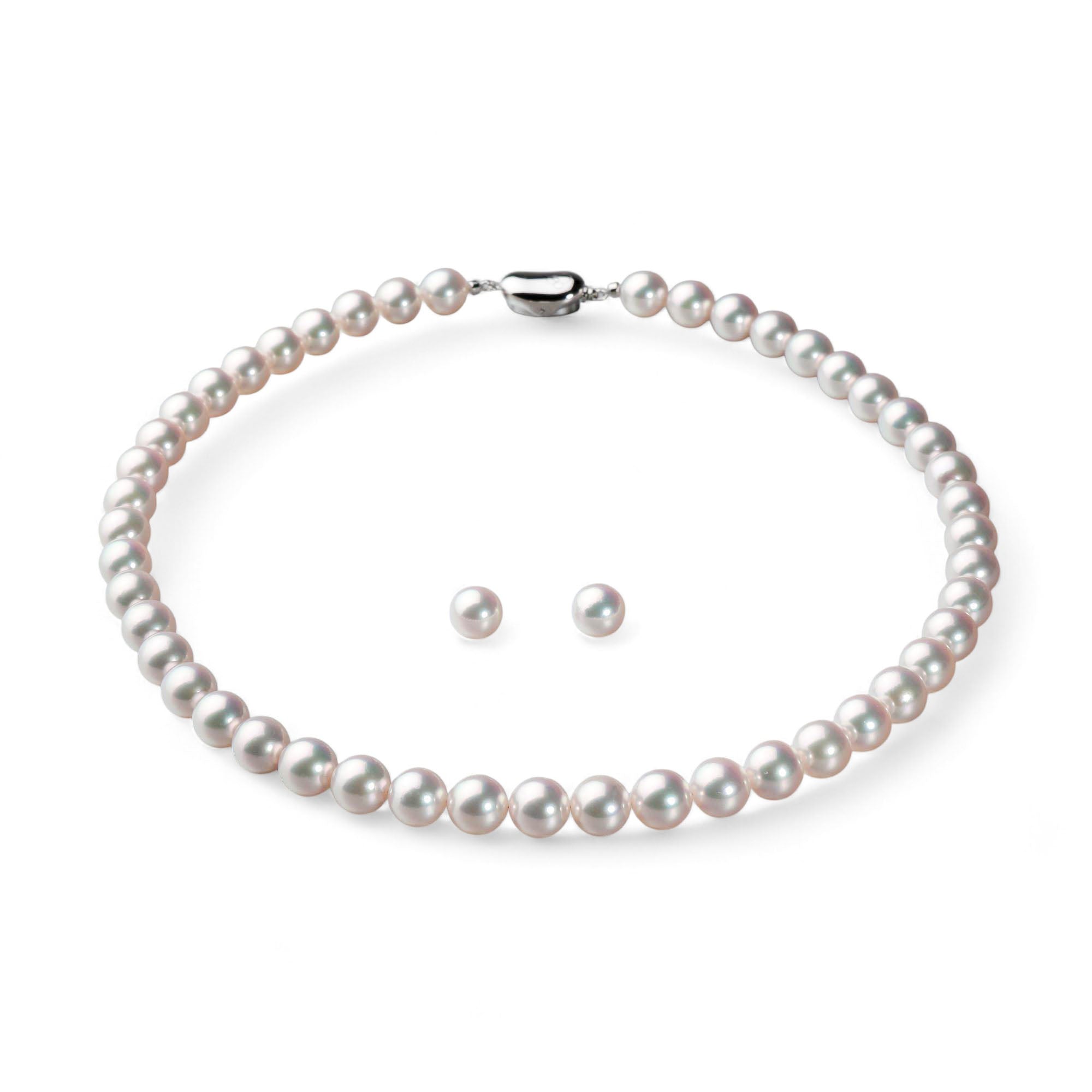
Akoya pearls are one of the standard pieces for ceremonial occasions: weddings, funerals, formal events. A strand with matching earrings gives you a composed look that doesn't move with trends.
Formal isn't the whole story anymore, though. Small pendants, station necklaces, hoop earrings, modern rings: there's a lot now that sits comfortably with what you already own.
Pearls you save for special days are one version of Akoya. Being able to bring that quality of light into an ordinary weekday is the other.
Akoya Pearls vs. Freshwater Pearls

Akoya and freshwater pearls are both real cultured pearls. What differs is where they grow and which mollusk makes them, and that shows up in how they look and what they cost.
Akoya grow in saltwater and run mostly white to cream. Freshwater pearls come from freshwater mussels, and their color range is much wider: white, pink, orange and purple. Shapes run from round through oval to baroque.
Shape and luster aren't fixed by type alone, though. They vary with quality and with the individual pearl. Look at the characteristics, the quality and how you plan to wear it, then choose from there.
Where They Grow
Akoya pearls are cultured in the Akoya oyster, a saltwater species. In Japan they're grown in calm coastal water, and the nacre forms under the influence of water temperature and the nutrients available.
Freshwater pearls come from mussels living in rivers and lakes. Most freshwater cultured pearls on the market today are farmed in China, and some mussels produce several pearls at once.
Different mollusk, different water, different method. That's what drives the differences in production volume, color, shape and price.
Luster, Shape, and the Impression They Leave
Akoya vary in shape and luster depending on quality and on the individual pearl. The better ones have a luster clear enough to catch reflected outlines, and paired with those white-based colors, the effect is classic and composed.
Freshwater pearls vary by quality too, and come in round, oval, drop and baroque. Colors run white, pink, orange and purple, which is part of why they turn up so often in design-led jewelry.
With either one, type alone doesn't settle quality or impression. When you're actually choosing, look at Luster, Shape, Color and design, and pick what suits where you'll wear it and what you like.
Price, and How You'll Actually Wear Them
Freshwater pearls are produced in high volume, which puts them across a wide price range. That makes them an easy way to wear pearls daily, or to try several designs without much hesitation.
Japanese Akoya take more work to farm, and more sorting to gather enough jewelry-quality pearls to match. Strands with strong Luster, even Shape and close matching between pearls generally cost more than freshwater equivalents.
Price isn't a ranking, though. A formal strand you'll keep for decades and a set of everyday pieces you'll rotate are two different jobs. Choose for the job.
Which Akoya Pearl Jewelry Is Right for You?

Akoya Pearl Necklace: The Formal Piece You'll Keep
A single-strand Akoya necklace is the piece that covers the widest range of formal occasions: weddings, school ceremonies, coming-of-age celebrations, funerals. It sits outside the trend cycle, so a well-made one stays useful for a very long time.
When you're choosing, look past size to Luster, Nacre thickness, Surface, Shape, Color and how evenly the pearls are matched. Smaller pearls read fine and quiet. Larger ones carry more presence.
If this is your first serious piece of Akoya jewelry, or you're looking for one thing to wear through the milestones ahead, the necklace is the place to start.
Akoya Pearl Earrings: Easy for Work, Easy for a Wedding
A single Akoya pearl at the ear brightens the whole face. In a simple stud, clip-on or pierced, it goes to a formal event and to your desk on Monday without any adjustment.
Wearing them with a necklace? Match the pearls for size, color and luster and the set reads as one thing. For everyday, smaller pearls or designs built onto hoops and chains feel lighter.
xThey're an easy entry point if you've never worn pearls, and an easy gift for the same reason.
Akoya Pearl Pendant: A Gift That's Simple to Get Right
An Akoya pendant is less formal than a strand, and an easy way to wear that Japanese Akoya luster day to day. A single-pearl pendant doesn't ask much of your outfit: shirts, knits, dresses all work.
Check the balance between pearl size, chain length and metal color. Smaller pearls are delicate and easy to wear often. Larger pearls, or a design set with diamonds, suit an anniversary or a milestone gift.
And you don't need to find out someone's ring size first, which makes a pendant one of the simpler things to give.
Akoya Pearl Ring: A Soft Light at Your Hands
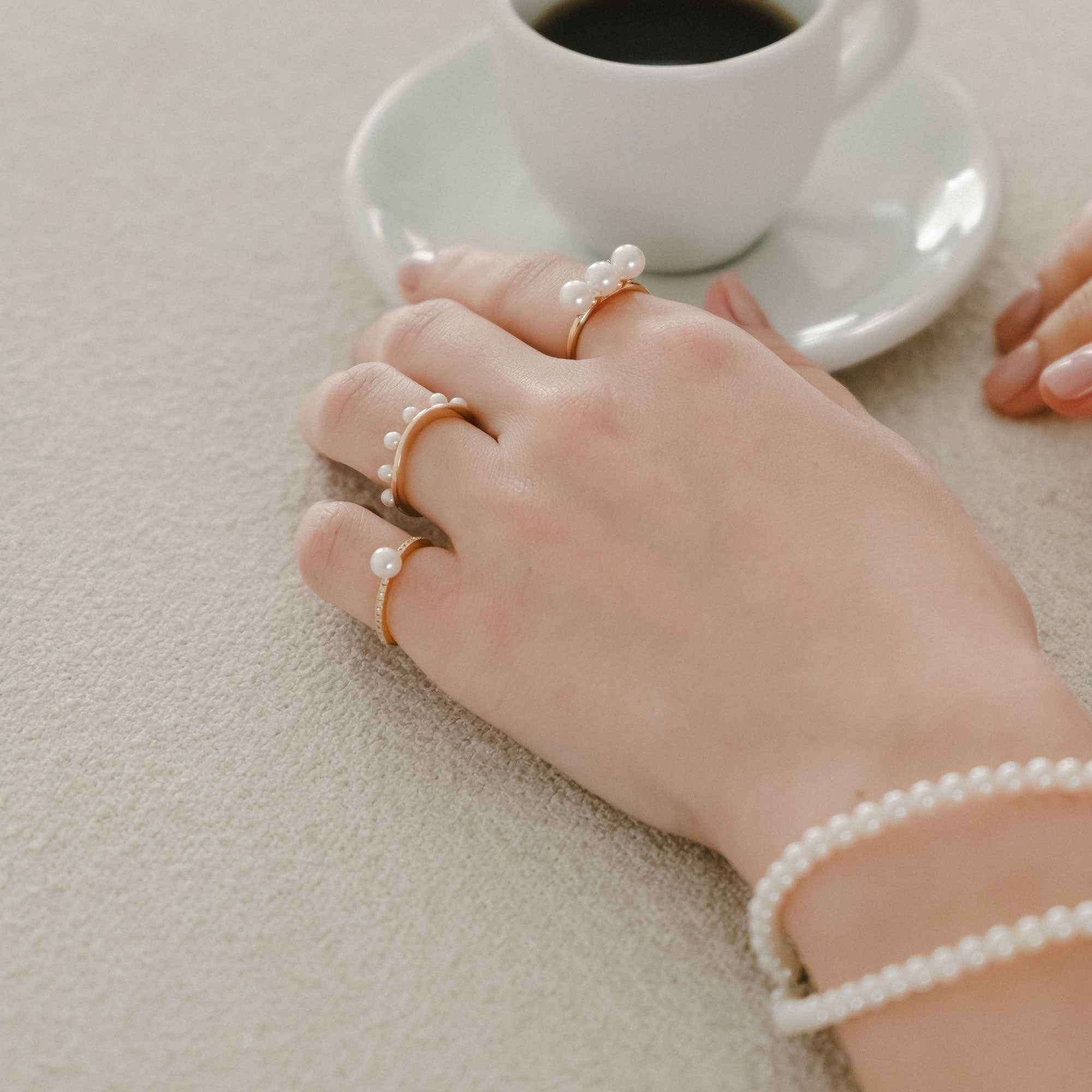
An Akoya ring puts a soft light at your hands. Designs run from a classic solitaire with one pearl at the center to modern settings that mix smaller pearls with diamonds.
Your hands stay in your own field of view all day, which is part of why a ring works as a marker for something: a milestone, or a gift to yourself. Alongside pearl size, check the metal and the width of the band, and think about what you'll be wearing it with.
Pearls don't like friction or knocks, so wipe yours with a soft cloth after wearing and store it where it won't grind against other jewelry. That's most of what keeping one beautiful takes.
Why Choose Akoya Pearls From WSP
WSP has been in the pearl wholesale business in Japan for over 30 years. That experience is what we bring to sorting: reading Luster, Nacre thickness and Surface pearl by pearl before anything becomes jewelry and ships from Japan to the rest of the world.
The Akoya collection at WSP Global uses pearls cultured in Japan's calm coastal waters. You'll find the formal staples, single strands and earrings, alongside pendants, rings and bracelets built for everyday wear.
We also grade against our own standard, weighing Luster, Nacre thickness and Surface together, so quality is easier to compare on a screen. If you're choosing Japanese-quality Akoya from abroad, that's the part that lets you understand what you're looking at before you decide.
In Summary: Choosing Japanese-Quality Akoya Pearl Jewelry
Akoya pearls are Japan's signature saltwater cultured pearl. Well-matched strands with close-to-round shapes, white-based colors and a luster that has real depth to it are what made them a classic in pearl jewelry worldwide.
Compared with freshwater pearls, they grow in different water and come from a different mollusk. Broadly, Akoya are known for even shape and luster, freshwater for range in color and form. Neither is better. A formal necklace, everyday earrings and a pendant for a gift are three different jobs, and the job is the thing to choose against.
WSP Global carries necklaces, earrings, pendants and rings made with Akoya pearls cultured in Japan. Have a look through what a Japanese pearl specialist has selected, and find the one you'll keep.


