
Types of Pearls

Find the pearl that's the most you.

There's more than one kind of pearl. Some grow in the ocean, some in lakes and rivers, and each type has a character of its own; in size, shape, color and the way it catches light.

Here's a look at each one, so you can find the pearl that fits you.

Akoya Pearls

Japan's signature pearl, and still most of what's farmed here today.

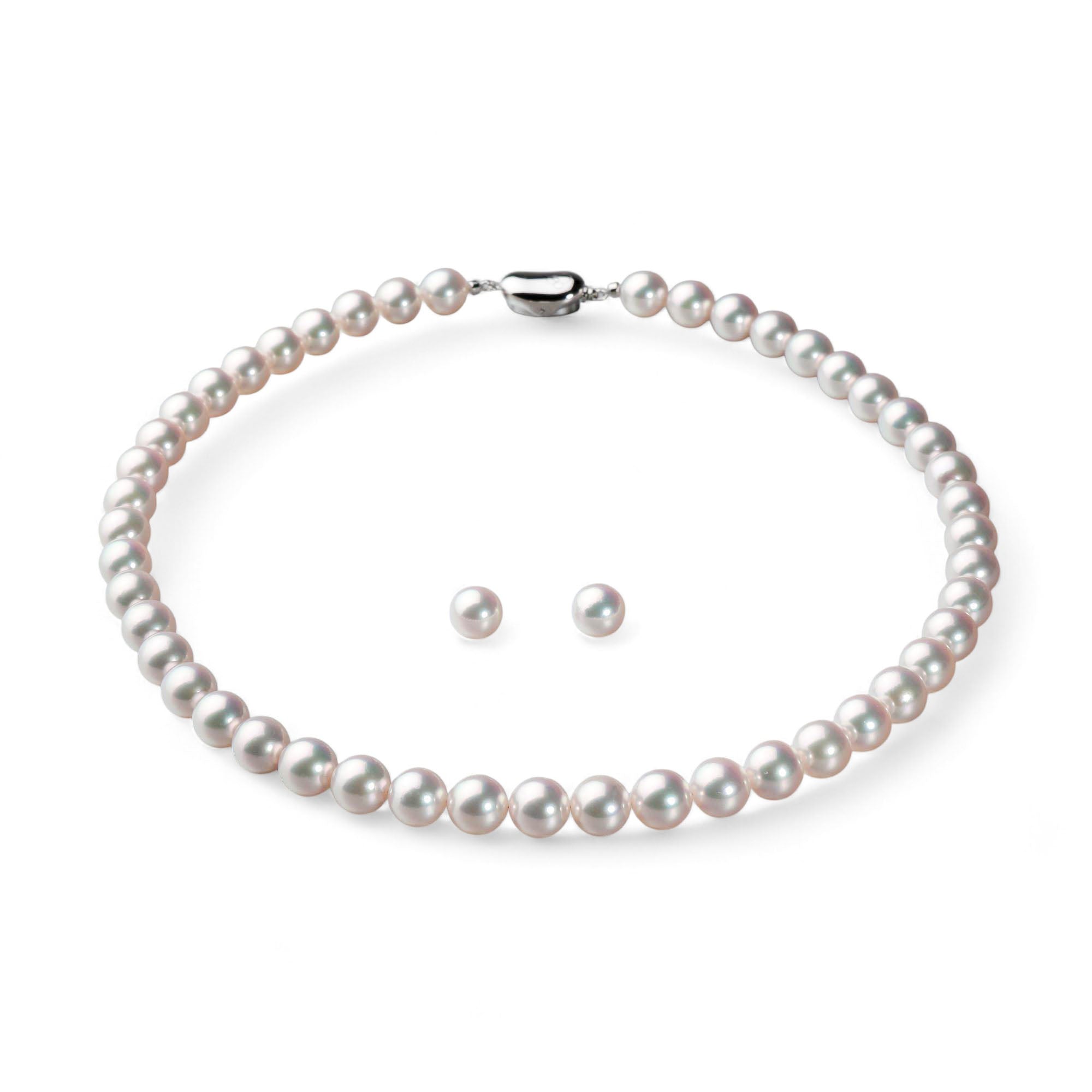
The oyster itself is only about the size of your palm, so Akoya pearls run roughly 2 mm to 10 mm, with 7.0 mm the size you'll see most often. What sets them apart is the luster: layer on layer of nacre (the coating the oyster builds up around the pearl) gives them a fine, subtly shifting glow. Most come in white-pink, white-green, cream and gold tones.

Because the Akoya oyster produces an unusually fine crystal structure, its pearls tend to come out rounder than other types. Sizes under 6 mm have been getting scarcer in recent years, which makes them harder to find.

Hanadama Akoya Pearls

Hanadama sits at the top of the Akoya scale: pearls a certifying laboratory has judged best-in-class on all five counts: Nacre thickness, Luster, Surface, Shape and Color; and issued a certificate for.

They're rare. Criteria vary a little between laboratories, though luster carries the most weight almost everywhere. Pearls do age over time, but the thick nacre on a Hanadama pearl slows that down considerably.

WSP only carries pearls certified by the Pearl Science Laboratory or the Pearl Research Laboratory; the oldest and most trusted pearl-specific laboratories in Japan.

Freshwater Pearls

Freshwater pearls come mostly from the Ikecho mussel, a large bivalve. In Japan they're farmed in Lake Biwa and elsewhere, though most of what reaches the market is imported from China.

Shape is where they get interesting. The oval "potato" pearl is the most common, but you'll also find rice, drop, coin and stick shapes — and the color range runs well past white into orange, pink and purple.

Most are non-nucleated, though better farming techniques have brought nucleated freshwater pearls to market in recent years. Some grow large and round enough to be mistaken for South Sea pearls, with a luster all their own.

South Sea Pearls

South Sea pearls come from the largest pearl oyster there is, large enough that a single pearl can reach about 19 mm across.

The color at the rim of the shell tells you which variety you're looking at: silvery white for the silver-lipped oyster, yellow for the gold-lipped. Silver-lipped is farmed mostly in Australian waters; gold-lipped is more common around Indonesia and the Philippines.

Silver-lipped oysters mostly yield white and silver pearls. Gold-lipped ones lean yellow and gold.

Tahitian Pearls

Tahitian pearls grow in the black-lipped oyster, farmed most famously around Tahiti in French Polynesia. You'll also hear them called black pearls.

The colors run wider than the name suggests; black, green, grey and red among them. The most prized is peacock: a deep green with a reddish flash when the light moves.

The black-lipped oyster is an active one, and the pearl often turns inside it as it grows. That's where the ringed "circle" pearls and the baroque shapes this type is known for come from.

Mabé Pearls

Mabé pearls, sometimes called blister pearls, are made differently from every other pearl on this page. A half-round nucleus is set directly against the inside of the mabé oyster's shell, and the oyster coats it in nacre. The shape follows the nucleus, so it isn't always a half-round.

They also have the thinnest nacre crystals of any pearl. Those thin layers stack up in a regular pattern, and light bouncing between them is what produces mabé's signature rainbow shimmer.

Colors range from white through metallic, aurora-like tones to blue.

Abalone Pearls

New Zealand abalone pearls — pāua pearls — are all about color. Blue, green and pink shift and mix depending on the angle you're looking from, and all of it is natural.

Pearls from abalone are genuinely rare, and they've been prized since ancient times as a pearl few people ever see. That scarcity, plus the color, is why finding one still feels like an event.